Rulebook
The UrbanMind rulebook defines the main principles and rules for all participants of an UrbanMind data space.
It explains how the data space works, who can join, what roles exist, and how participants are expected to integrate their data and collaborate with other participants within the data space.
Business Model
UrbanMind is just one of the many data space implementations out there. Why would we choose UrbanMind over the other implementations, you might ask?
- Because it strives to be simple. UrbanMind does not have a steep learning curve. You will feel right at home in a matter of hours, not weeks.
- Because it is multi-tenant. You will likely share the same UrbanMind instance with other organizations. In case that you are part of a larger organization each interested department can also be onboarded as its own isolated participant.
- Because it can act as a digital twin. UrbanMind can also be used as a simple digital twin. Its service integration and use case functionalities let you quickly build interactive real-time dashboards with data from external services.
- Because of its minimal requirements. UrbanMind pretty much runs as a single executable which can be deployed in various environments - in a virtual machine, as a container, on "bare metal" Linux or Windows machines, you name it.
- Because it is opinionated. UrbanMind will force you into using specific standards, such as data models, APIs, and services, which are shared by all of its participants. Everyone "speaks the same language" across all instances of UrbanMind.
- Because it is extendable. Its service, widget, and connector implementations are implemented in such a way that new ones can be introduced in no time. All you have to do is ask.
- Because it is well documented. You should be able to easily find all the documentation that you will ever need to use UrbanMind within UrbanMind. The documentation is embedded into UrbanMind itself and is kept up to date with each release.
- Because you do not necessarily have to install anything to use UrbanMind. In the majority of cases you can simply join an UrbanMind instance as a participant. You do not necessarily have to install a connector. In case that you already have a more common data space connector implementation running there is a chance that you will be able to integrate it right into UrbanMind, which will unlock functionality such as catalog federation and federated data transactions.
- Because it supports white-labeling. UrbanMind's look and feel can be adjusted at runtime without making changes to its source code or configuration.
Can we perhaps interest you in your very own managed UrbanMind instance? Reach out to urbanmind@3fs.si to get started.
For those that would simply like to join as a participant or take UrbanMind for a spin (get access to a demo account) - you should be able to find the details in the sections below.
Use Case Development
Use cases in UrbanMind build on the use case concept from the data space blueprint. They can be materialized in the form of (live) dashboards.
More information can be found in the user guide.
Data Space Offerings
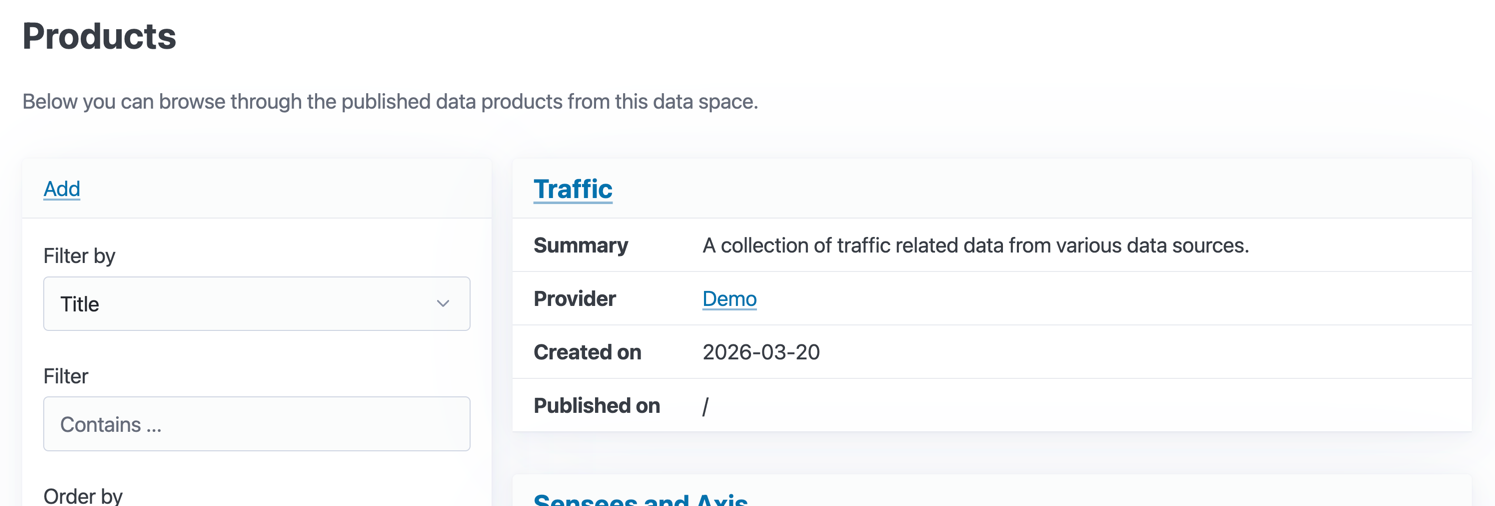
Offerings are represented using products and resources. Products are bundles of a participant's resources, access to which is controlled by an offer attached to the product. Resources can also be obtained individually.
In UrbanMind participants do not have the ability to offer services to other participants. Its service catalog is part of UrbanMind itself. Participants are however free to request additional services to be integrated.
Instructions for product creation and other information about them can be found in the user guide.
Intermediaries and Operators
UrbanMind data space instances are managed and operated by 3fs. While UrbanMind as such does not have any intermediaries providing services (everything is self-contained and built on open source technologies) some of the participants might - think identity, access, and data service providers.
The operator's responsibilities include but are not limited to:
- Technical operation and maintenance of the platform
- Managing access, monitoring performance, and ensuring data security
- Supporting compliance with the EU Data Act, GDPR, and DS4SSCC principles
Organizational Form and Governance Authority
Each UrbanMind instance is governed by a consortium of companies, composed of an operator, an onboarding coordinator, and (or) one or more founding participants.
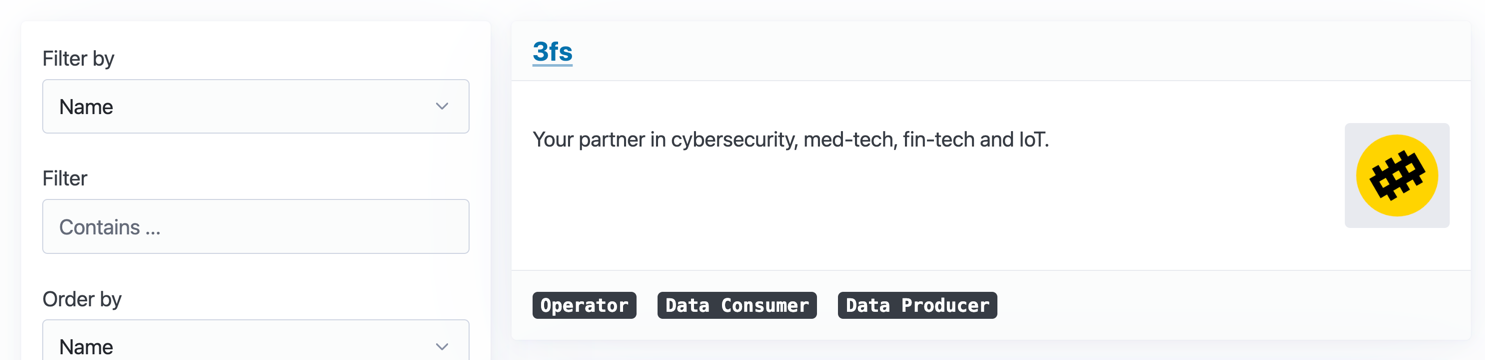
The rest of the participants fulfill the data provider and data consumer roles in the data space.
The roles of each participant are publicly disclosed and can be found in the participant catalog.
Participation Management
The first step of the participant onboarding process is manual and requires the interested party to reach out to an operator of the UrbanMind instance or one of the participants that fulfills the governance authority role.
See the Onboarding section in the user guide for details.
During the onboarding process participants get assigned roles which then get propagated to their users.
See the Roles section of the user guide for details about the available roles and how they can be distributed among a participant's users.
Regulatory Compliance
Details about how UrbanMind handles data privacy can be found in the privacy statement.
Contractual Framework
In UrbanMind data product contracts are built around the Open Digital Rights Language (ODRL). An engine for their management and evaluation is embedded into UrbanMind itself. More information about offers can be found in the user guide.
Data-sharing agreements are represented using contracts.
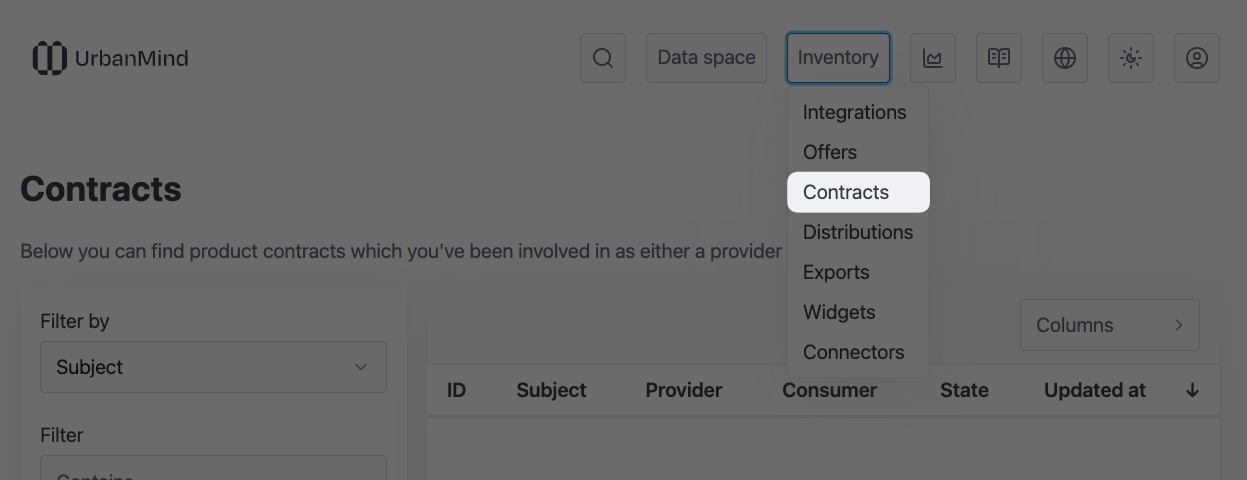
Internally data service contracts do not exist as a concept since the majority of the services in UrbanMind are merely API clients for external services which have to be provisioned by the participant outside of UrbanMind - think data services through which data is exposed to UrbanMind, etc.
The rest of the of the contracts are established during the participant onboarding process.